
The DP Pattern
Flowchart
The hard part of dynamic programming isn't the code — it's deciding what the state is. Answer a few questions about the problem and the flowchart points you at one of five shapes.
From the creator of Tech With Nikola (67K+ subscribers, 2M+ video views)
Get the Free PDF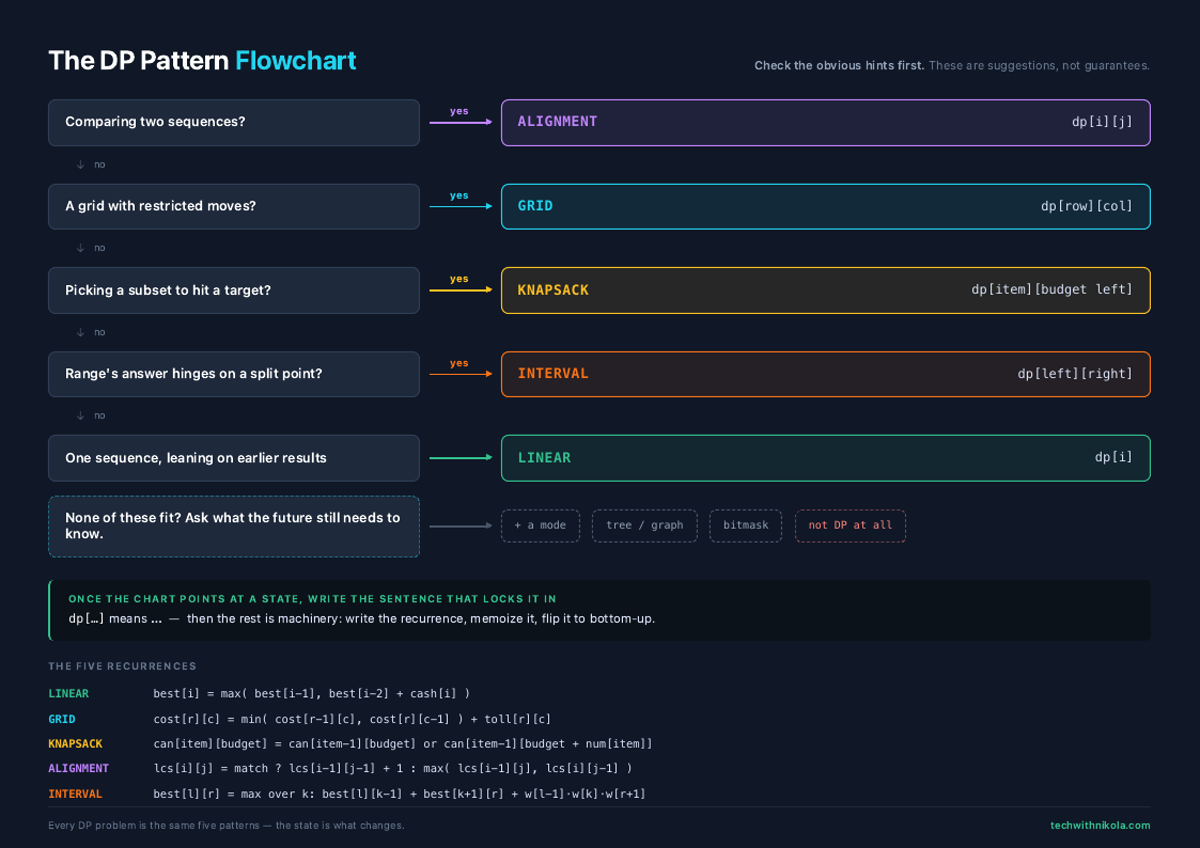
Read the state off the problem statement
Five questions, checked in order of how obvious the hint is: two sequences? a grid with restricted moves? a subset hitting a target? a range that splits? one sequence leaning on earlier results? Each answer names the state.
An escape hatch for the ones that don't fit
When no branch matches, there's one underlying question to fall back on — what does the future still need to know? — plus the usual answers: an extra mode, a tree, a bitmask, or that it isn't dynamic programming at all.
All five recurrences, written out
Linear, grid, knapsack, alignment and interval — the actual formulas, with the index conventions that match how the states are drawn, so you're not translating between two versions of the same idea.
One sentence that locks it in
Once the chart points at a state, you write "dp of this means…" — and from there it's machinery you can practise: the recurrence, memoization, bottom-up.
Get the flowchart
Enter your email and I'll send you the PDF — plus the DP Cheatsheet, Git Cheatsheet and Senior Engineer Checklist.